
Body Language 101: Reading Dogs at the Dog Park to Prevent Aggression
Hey there, friends — it's Auggie, your favorite curly-coated Golden Doodle and self-appointed dog park diplomat! If there's one thing I've learned from hundreds of park visits with my mom Lacey, it's that understanding dog park aggression starts long before a growl or a snap. It starts with the subtle stuff — a stiffened tail, a hard stare, a shift in weight. Most humans walk right past these signals like they're invisible, but to us dogs, they're screaming. That's why I wanted to write this guide on reading canine body language at the dog park. Whether you're a first-time pup parent or a seasoned park-goer, knowing how to spot tension before it escalates is the single best thing you can do for dog park safety. So grab a treat (I won't judge if it's for you), and let's decode what we dogs are really saying out there.
Why Understanding Dog Park Aggression Starts With Body Language
Let me be honest with you: most incidents of dog park aggression don't come out of nowhere. They build. Slowly, quietly, through a series of signals that we dogs broadcast loud and clear — if you know what to look for.
According to VCA Animal Hospitals, aggression in dogs can stem from fear, pain, territorial instincts, or resource guarding, and it often manifests through predictable body language cues long before any physical altercation. The problem? Most humans are chatting with other humans, scrolling their phones, or tossing a ball without really watching us.
My mom Lacey learned early on to keep her eyes on me and the dogs around me. She says it's like being a lifeguard at a pool — you can't protect anyone if you're not paying attention. And honestly? That mindset has kept us both safe more times than I can count on my adorable little paws.
The Friendly Signals: What Relaxed Dogs Look Like
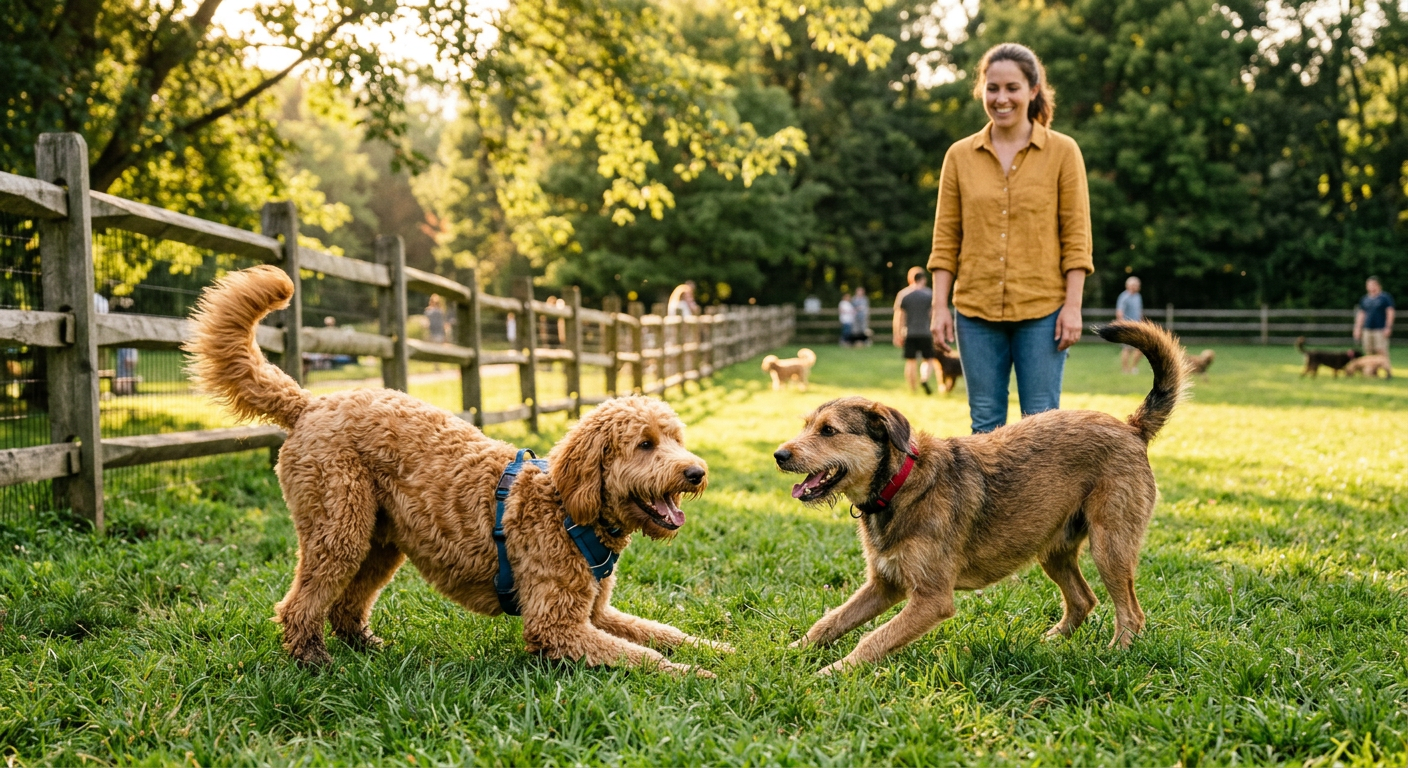
Before we dive into the scary stuff, let's talk about what good looks like. When I'm having a blast at the park, here's what you'll see:
- Loose, wiggly body: My whole back end is swaying. I look like a furry noodle.
- Play bow: Front legs down, butt up in the air — the universal dog invitation that says, "Let's GO!"
- Soft eyes and relaxed mouth: My mouth might be open in a happy pant, and my eyes are soft, not laser-focused.
- Bouncy movements: I'm hopping around like a goofball, changing direction, taking breaks.
- Role reversal in play: I'll chase, then let the other dog chase me. We take turns being "it."
These are the signs of healthy, balanced play. When all the dogs in a group look like this, you're in a good spot. But the moment these signals start disappearing, it's time to pay closer attention.
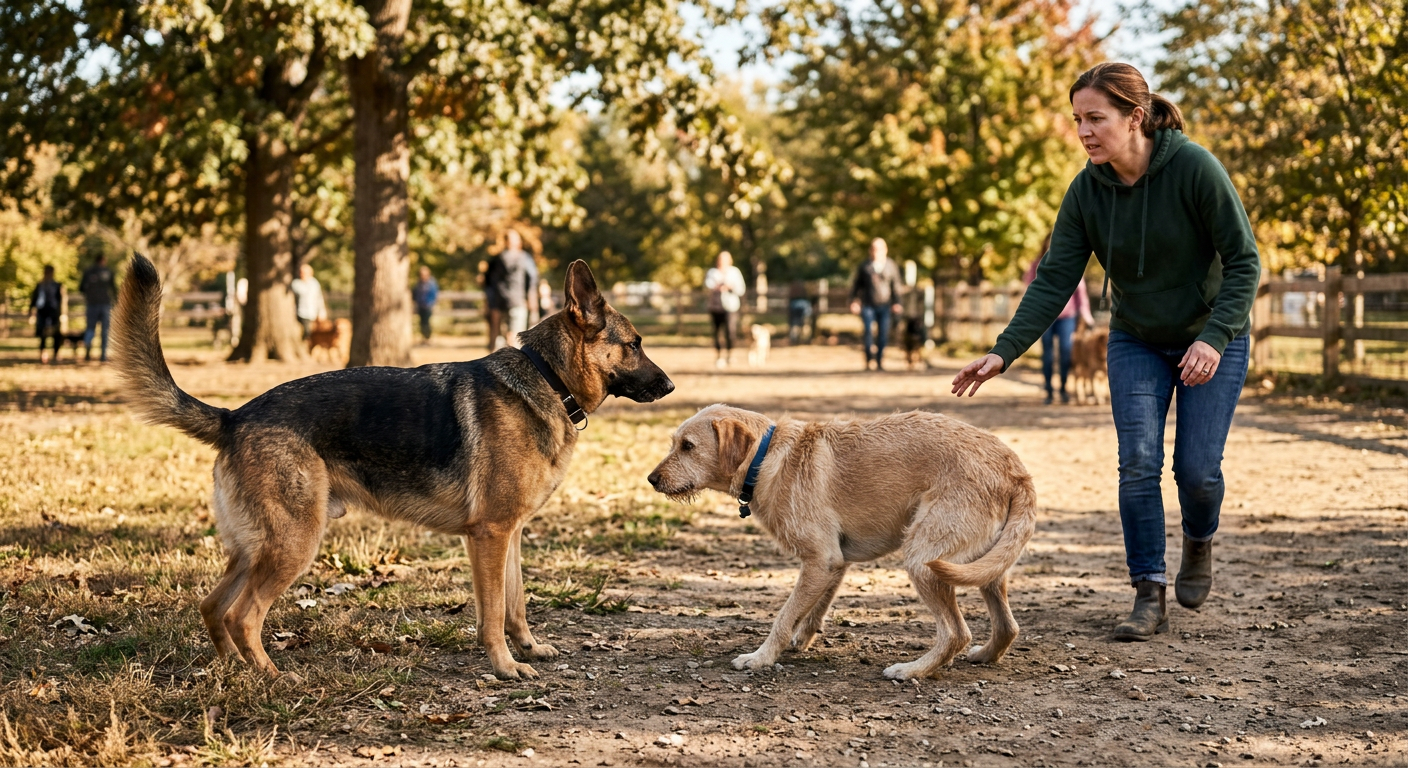
The Warning Signs: Early Indicators of Dog Park Aggression
Here's where things get critical. Dog park aggression rarely starts with a bite. It starts with these subtle — and sometimes not-so-subtle — warning signs:
Stiff Body Posture
When a dog goes from wiggly to rigid, that's a red flag. A stiff body means a dog is on high alert. Their muscles tense, their tail may go straight up or become very still, and their weight shifts forward. As Animal Hospital of West Lake Forest explains, stiff posture and freezing are key indicators that a dog's dominance or prey drive has been triggered.
Hard Stare
A relaxed dog glances around. An aroused or aggressive dog locks on. If you see a dog staring unblinkingly at another dog — especially with a closed mouth and forward-leaning posture — that's not curiosity. That's a challenge.
Raised Hackles
Those hairs along a dog's spine standing up? That's called piloerection, and it means heightened arousal. It doesn't always mean aggression (sometimes it's excitement or fear), but combined with other signals, it's a serious warning.
Freezing
This one catches a lot of people off guard. A dog who suddenly goes perfectly still — mid-sniff, mid-interaction — is not "being polite." Freezing is often the last calm signal before a snap or lunge. If you see a dog freeze, it's time to calmly intervene.
Lip Curling, Showing Teeth, or Growling
These are the more obvious signs, and by the time you see them, you're already in the danger zone. A growl is actually a gift — it's a dog saying, "I'm uncomfortable, please back off" — but it means the situation has already escalated past the early warning phase.
T-Posture (Standing Over Another Dog)
When one dog places their head or chin over another dog's shoulders or back, that's a dominance signal. If the dog on the receiving end doesn't defer, things can escalate fast.
What Triggers Dog Park Aggression in the First Place?
So why do perfectly sweet dogs sometimes turn into park bullies? There are several common triggers, and understanding them is essential for dog park safety.
Fear and Anxiety
According to Today's Veterinary Practice, fear is one of the most common underlying causes of aggression in dogs. A dog who feels cornered, overwhelmed by too many new dogs, or is in an unfamiliar environment may lash out defensively. This is especially common in under-socialized dogs or dogs who've had negative park experiences in the past.
Pain or Medical Issues
Here's something a lot of people don't consider: a dog in pain has a much lower threshold for aggression. If your normally chill pup suddenly snaps at another dog, a vet visit should be your first stop — not a training correction. Neurological conditions, joint pain, and even ear infections can make a dog more reactive.
Resource Guarding
Balls, treats, water bowls, even favorite humans — dogs can guard resources at the park just like they do at home. I'll admit, I get a little weird when another dog tries to steal my favorite Chuck-It ball. My mom Lacey knows to bring multiple toys or skip them entirely on busy days.
Disrupted Social Order
A peer-reviewed study published on PubMed Central notes that dog parks can trigger dominance and prey drives, especially when new dogs enter an established group. Think of it like a stranger walking into a house party uninvited — some dogs handle it fine, others… not so much.
Overstimulation
Too much running, too many dogs, too much noise — overstimulation is real, and it's a major contributor to dog park aggression. Even I, a social butterfly of the highest order, need breaks. My mom watches for my signal (I usually go sit by her feet) and we step outside the fence for a breather.
Dog Park Etiquette: Rules That Prevent Aggression
Good dog park etiquette isn't just about being polite — it's about preventing dangerous situations. Here are the rules my mom Lacey and I live by:
1. Always Observe Before Entering
We never just barge through the gate. Lacey scans the park first. How many dogs are there? What's the energy level? Are there any dogs she's seen be reactive before? This 30-second assessment has saved us from bad situations more than once.
2. Remove Leashes Inside the Off-Leash Area
This sounds counterintuitive, but keeping a dog leashed in an off-leash park can actually increase aggression. A leashed dog feels trapped and can't use normal body language to navigate social interactions. It's called leash reactivity, and it's a real thing.
3. Supervise Actively
Put. The. Phone. Down. Seriously. You need to be watching your dog at all times. If you see any of the warning signs I described above, you need to be ready to calmly redirect or remove your dog.
4. Know When to Leave
If the energy in the park is too high, if there's a dog who's bullying others, or if your dog is showing signs of stress (lip licking, yawning, whale eye, tucked tail), it's okay to leave. There's no shame in the safety game.
5. Use Separate Areas for Small and Large Dogs
That PubMed Central study I mentioned earlier specifically recommends design strategies like separate areas for small and large dogs to reduce interdog incidents. If your park has them, use them. Size mismatches are a recipe for prey-drive activation.
To help with active supervision and recall training, I highly recommend having the right gear. The PetSafe Treat Pouch Sport keeps high-value treats right at your hip for quick rewards when your dog checks in with you. And a reliable long lead like the Hi Kiss Long Dog Training Leash is great for practicing recall in open areas before graduating to a fully off-leash park.
How to Safely Intervene During Dog Park Aggression
Okay, so the worst happens. Two dogs are going at it. What do you do?
What TO Do:
- Stay calm. Panicking and screaming escalates the situation for everyone — dogs included.
- Use a loud, firm interrupt sound — a clap, an air horn, or a sharp "HEY!" can sometimes break the focus.
- The wheelbarrow technique: If you must physically intervene, grab the aggressing dog's hind legs and pull back in a gentle arc. This removes their ability to lunge forward while keeping your hands away from the bitey end.
- Create a barrier: If you have a jacket, a bag, or even a chair nearby, slide it between the dogs.
What NOT to Do:
- Never reach for a dog's collar or face during a fight. That's how most human injuries happen.
- Don't punish the dogs afterward. Yelling or hitting will only increase fear and make future aggression more likely.
- Don't use aversive tools like prong or shock collars as a "fix." As Today's Veterinary Practice emphasizes, aversive techniques can escalate aggression rather than resolve it.
For emergency situations, having a Pet Corrector Spray in your park bag can provide a short burst of compressed air that often interrupts fixated behavior safely. And every park bag should include a PetArmor Antiseptic Wound Spray for treating any minor scrapes or punctures before you can get to a vet.
Building a Positive Dog Park Experience Near You
Here's the good news: a study indexed on PubMed found that interdog aggression at off-leash "bark parks" is actually quite rare, posing limited risk to dogs and their owners. The vast majority of park visits are exactly what they should be — joyful, social, and enriching.
To set your pup up for success at a dog park near you:
- Start with quieter parks during off-peak hours so your dog can build confidence without being overwhelmed.
- Practice solid recall before going off-leash. Your dog should come back to you reliably, even with distractions. The KONG Classic Dog Toy stuffed with peanut butter is my personal favorite high-value reward for recall practice.
- Socialize gradually. Don't expect your dog to love the park on day one. Build up to it.
- Check your park's rules and layout — parks in your area may have different regulations about vaccinations, spay/neuter requirements, and designated areas.
- Consider your dog's individual needs. Not every dog is a park dog, and that's perfectly okay. Some dogs thrive in smaller playgroups or on structured walks instead.
When to Seek Professional Help for Dog Park Aggression
If your dog is consistently showing aggression at the park — or anywhere — it's time to consult a professional. And I don't mean your neighbor who "knows dogs." I mean a certified veterinary behaviorist or a certified applied animal behaviorist (CAAB).
VCA Animal Hospitals notes that the best outcomes for aggression cases come from a multi-faceted approach: behavior modification, environmental management, and in some cases, medication like SSRIs (such as fluoxetine). Aggression doesn't have a "cure," but it can be managed effectively with the right professional guidance.
My mom Lacey always says, "There's no shame in asking for help — only in not asking." And she's right. (Don't tell her I said that. She'll get a big head.)
The key takeaway for dog park safety is this: prevention is always better than intervention. Learn the body language, respect the signals, practice good dog park etiquette, and don't be afraid to advocate for your dog — even if that means leaving the park early.
Well, friends, we covered a lot of ground today — almost as much as I cover when I get the zoomies at the park! Understanding dog park aggression isn't about being scared of the park; it's about being prepared, observant, and respectful of every dog's boundaries (including your own pup's). My mom Lacey and I have built an incredible park life together by learning to read the room — or rather, the yard — and I know you can too. Start by watching, keep learning, and trust your gut when something feels off. If you found this guide helpful, share it with your dog park crew, and check out our other posts on doggieparknearme.com for more tips on finding great parks near you, staying safe, and living your best doggy life. Now if you'll excuse me, there's a squirrel outside that needs my immediate attention. 🐾
— Auggie
Frequently Asked Questions
Why is my dog aggressive at dog park?
Dog park aggression can stem from several causes including fear, anxiety, pain, resource guarding, lack of socialization, or overstimulation. Some dogs become reactive when they feel overwhelmed by too many unfamiliar dogs, while others may have underlying medical issues that lower their threshold for aggression. A dog who is normally friendly at home may behave differently in the chaotic, high-energy environment of a dog park. If your dog is consistently aggressive at the park, consult a certified veterinary behaviorist to identify the root cause and develop a behavior modification plan.
What is the 7 7 7 rule for dogs?
The 7-7-7 rule is a socialization guideline suggesting that by the time a puppy is seven weeks old, they should have been on seven different surfaces, eaten from seven different containers, been in seven different locations, met seven new people, been exposed to seven different challenges or obstacles, eaten from seven different containers, and heard seven different noises. This rule emphasizes early, diverse exposure during critical developmental windows to build a confident, well-adjusted dog — which directly reduces the likelihood of fear-based aggression later in life at places like dog parks.
Why don't vets recommend dog parks?
Some veterinarians express caution about dog parks due to risks including disease transmission (like kennel cough, parvovirus, and intestinal parasites), potential for dog fights, and the unpredictability of other dogs' behavior and vaccination status. Puppies who haven't completed their full vaccination series are especially vulnerable. However, many vets do support dog park use for properly vaccinated, well-socialized adult dogs — they simply recommend active supervision, knowing your dog's body language, choosing well-maintained parks, and avoiding peak hours when overcrowding increases the risk of conflict.
What is cobbing in dogs?
Cobbing is when a dog gently nibbles on you, another dog, a blanket, or a toy using their front teeth in a corn-on-the-cob-like motion. It's generally a sign of affection, grooming behavior, or self-soothing. Cobbing is typically harmless and shouldn't be confused with aggressive nipping or biting. At the dog park, you might see a dog cobbing on their owner's arm after play — it's usually a sign of contentment and bonding, not a precursor to aggression. However, if cobbing becomes obsessive or is directed at other dogs who don't welcome it, gentle redirection is a good idea.
About Auggie
Hi, I'm Auggie! I'm a Golden Doodle who's been to more dog parks than most humans. My mom Lacey and I started Doggie Park Near Me to help every pup find their perfect park. When I'm not sniffing out new spots, you'll find me napping in the sun or begging for treats.
Learn more about us →More From Auggie

How to Handle a Dog Fight at the Dog Park: Tips from a Golden Doodle Who's Seen It All
Woof! It's Auggie here, and today I'm tackling a topic every dog park visitor needs to know: dog park aggression. From recognizing warning signs to safely breaking up a fight, I'm sharing everything my mom Lacey and I have learned about keeping pups safe at the park. Let's dig in!

Reactive Dogs and Dog Parks: Can They Coexist? A Guide to Dog Park Aggression Training
Hey friends, it's Auggie! Got a reactive pup who struggles at the dog park? I've been there! In this guide, I share expert-backed dog park aggression training tips — from medical screening and trigger identification to step-by-step desensitization. Every dog deserves a chance at a happy park life. 🐾

Dog Aggression at the Park: Warning Signs and What to Do
Hey, it's Auggie! Dog park aggression is no joke — I've seen sunny park days turn tense in seconds. In this post, I break down the warning signs of aggression, what to do if a fight breaks out, and how to keep your pup safe. From body language cues to training tips, let's make every park visit a good one. 🐾