
Therapy Dogs vs. Service Dogs: What's the Difference?
Hey there, friends — it's me, Auggie, your favorite curly-haired Golden Doodle and resident doggo expert here at doggieparknearme.com! If there's one thing I know from personal experience, it's that dogs like me have a special superpower: we can make humans feel better just by being our adorable, tail-wagging selves. That's probably why so many people are curious about getting a therapy dog for mental health support these days. But here's where things get a little confusing — even for a smart pup like me. The terms "therapy dog," "service dog," and "emotional support animal" get tossed around like tennis balls at the park, and most humans use them interchangeably. Spoiler alert: they're actually very different things with different legal protections, training requirements, and roles. My mom Lacey and I have done a deep dive (she did the reading, I provided moral support) to help you understand exactly what sets these amazing working dogs apart — and which one might be the best fit for you or someone you love.
Why Dogs Are Powerful Allies for Mental Health
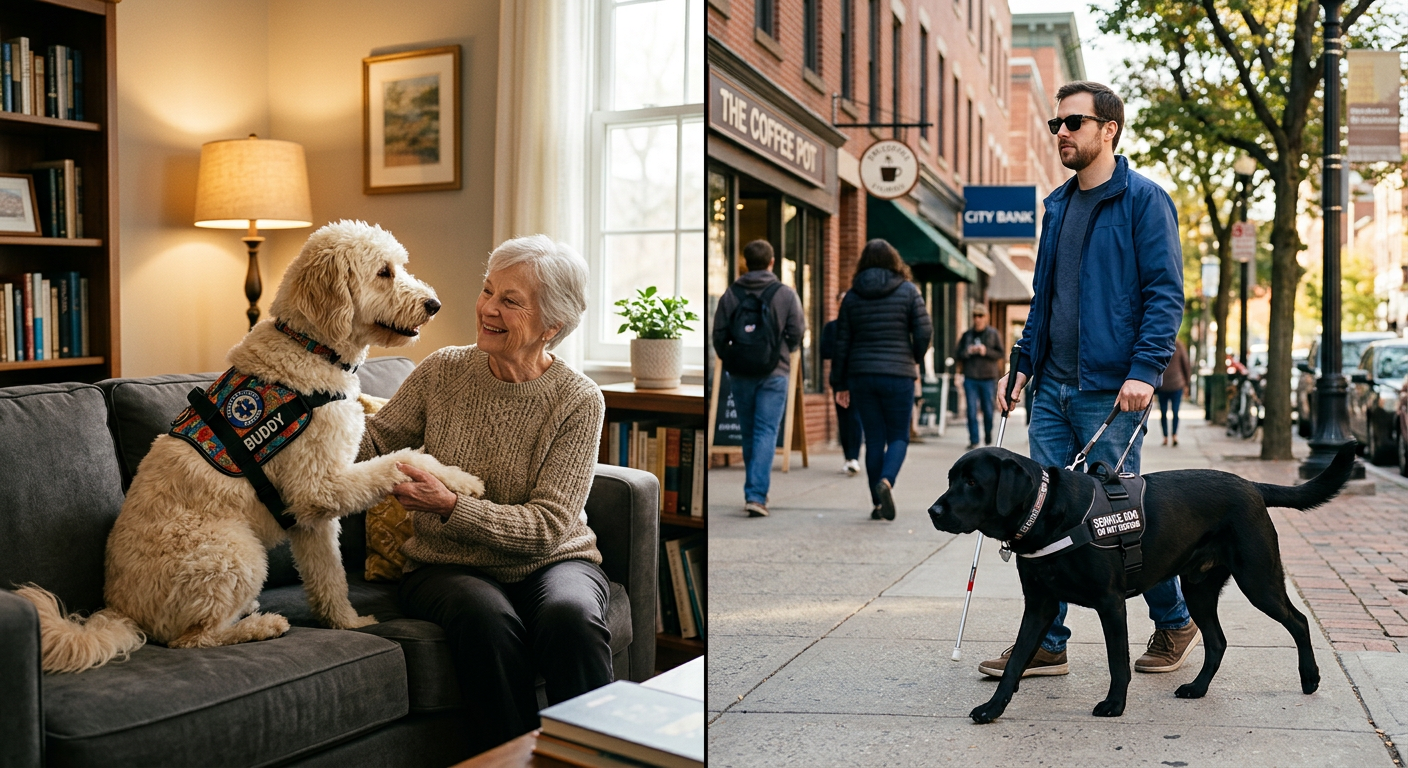
Before we dig into the differences between therapy dogs and service dogs, let me tell you why dogs in general are such incredible mental health allies. I'm not just saying this because I'm a dog (okay, maybe a little). The science actually backs me up here — big time.
Research published by the National Center for Biotechnology Information (PubMed Central) explains that dog interactions reduce anxiety and distress through emotional regulation, social support, and biological mechanisms like tactile distraction. In plain puppy terms? When you pet a dog, your brain releases oxytocin (the "love hormone") while cortisol (the stress hormone) drops. Your blood pressure goes down. Your breathing slows. You just… feel better.
And this isn't just about cuddling on the couch. A study highlighted by the Ohio State University Wexner Medical Center found that healthcare workers reported nearly double the positive mood improvement after brief therapy dog sessions, with decreased emotional exhaustion and burnout. That's a pretty big deal when you consider how stressed those humans are.
So whether we're talking about a therapy dog for mental health or a fully trained service dog, the fundamental truth remains: dogs help humans heal. Now let's break down exactly how these roles differ.
What Is a Therapy Dog for Mental Health?
A mental health therapy dog is a dog that has been trained and certified to provide comfort, affection, and emotional support to people in various settings — think hospitals, nursing homes, schools, disaster relief areas, and courtrooms. These dogs don't belong to the individuals they help. Instead, they're typically owned by a handler (hi, that could be someone like my mom Lacey!) who volunteers their time to visit facilities and share the healing power of their pup.
Here's the thing that makes therapy dogs extra special: we're all about spreading the love widely. A therapy dog for mental health might visit a children's hospital in the morning and a college campus during finals week in the afternoon. Our job is to be calm, friendly, well-behaved, and open to meeting lots of different people.
The results speak for themselves. According to the Human Animal Bond Research Institute (HABRI), therapy dogs in emergency departments reduced child anxiety scores in 46% of cases versus only 23% in control groups. Even more impressive? The need for anxiety medications dropped from 55% to 35% when a therapy dog was present. That's a 20-percentage-point decrease just from having a good boy or girl in the room!
In nursing home settings, residents who interacted with therapy dogs showed significant reductions in depression symptoms compared to those without animal-assisted interactions. A comprehensive review on PubMed Central evaluated therapy dogs' role in health promotion, highlighting their meaningful impact on human mental well-being through structured human-animal interactions.
How Therapy Dogs Get Certified
Therapy dogs aren't born — well, okay, we're born adorable — but we're also trained and evaluated. Most therapy dog organizations require:
- Basic obedience mastery (sit, stay, come, down, leave it)
- Canine Good Citizen (CGC) certification through the AKC
- Temperament evaluation to ensure the dog is calm, friendly, and not easily startled
- Handler training so the human knows how to manage visits appropriately
- Health requirements including up-to-date vaccinations and regular grooming
Organizations like Pet Partners, Therapy Dogs International, and Alliance of Therapy Dogs offer registration programs available near you in most areas across the country.
If you're working on basic obedience with your pup (the foundation for any therapy dog career), I highly recommend the PetSafe Treat Pouch Sport — my mom Lacey swears by it for keeping treats handy during training sessions without fumbling around in her pockets.
What Is a Service Dog?
Now let's talk about service dogs, because this is where things get more serious — and more legally defined. A service dog is individually trained to perform specific tasks for a person with a disability. Under the Americans with Disabilities Act (ADA), service dogs have legal protections that therapy dogs and emotional support animals do not.
Service dogs can:
- Accompany their handler in all public places (restaurants, stores, airplanes)
- Live in housing regardless of pet policies
- Cannot be denied access based on breed, size, or weight
Types of Service Dogs
Service dogs are trained for a wide variety of disabilities:
- Guide dogs for individuals who are blind or visually impaired
- Hearing dogs that alert deaf or hard-of-hearing individuals to sounds
- Mobility assistance dogs that help with balance, retrieving items, or opening doors
- Psychiatric service dogs trained to detect and respond to psychiatric episodes (panic attacks, PTSD flashbacks, dissociative episodes)
- Seizure alert dogs that detect and respond to epileptic seizures
- Diabetic alert dogs that detect blood sugar changes

Psychiatric Service Dogs vs. Therapy Dogs for Mental Health
This is where I see the most confusion among humans, so let me clear it up with my best serious face (which my mom Lacey says still looks pretty goofy).
A psychiatric service dog is a type of service dog trained to perform specific tasks related to a mental health disability — like interrupting self-harm behaviors, performing deep pressure therapy during a panic attack, or waking someone from PTSD nightmares. These dogs have full ADA protections.
A therapy dog for mental health, on the other hand, provides general comfort and emotional support in therapeutic settings but doesn't have public access rights. Therapy dogs work in facilitated environments and are not assigned to one individual.
Here's a quick comparison:
| Feature | Therapy Dog | Service Dog |
|---|---|---|
| Trained for | General comfort and emotional support | Specific tasks for a disability |
| Legal access | Only where invited | All public places (ADA) |
| Handler | Volunteer owner/handler | Person with disability |
| Certification | Through therapy dog organizations | No legal certification required, but task-trained |
| Who benefits | Many people in various settings | One specific individual |
What About Emotional Support Animals (ESAs)?
I can almost hear you thinking: "But Auggie, what about emotional support animals?" Great question! ESAs occupy a third category that's different from both therapy dogs and service dogs.
An emotional support animal provides comfort through companionship to an individual with a mental health condition. They're prescribed by a licensed mental health professional. However, ESAs:
- Do not require specific task training
- Do not have public access rights under the ADA
- Do have some housing protections under the Fair Housing Act
- Are no longer guaranteed airline access (as of 2021 DOT rule changes)
Any dog can technically be an ESA — you don't need special training or certification. But honestly? Every dog benefits from good training. If your ESA could use some help with anxiety themselves (it happens — trust me, I've met nervous Nellies at the dog park), the ThunderShirt Classic Dog Anxiety Jacket works wonders. The gentle, constant pressure is like a hug you can wear.
How to Choose the Right Mental Health Support Dog for You
So you've decided you want a dog to support your mental health. Wonderful choice (I'm biased, obviously). But which path is right for you?
Consider a Therapy Dog If:
- You want to volunteer and help others in your community
- You already have a calm, friendly, well-socialized dog
- You want to bring joy to hospitals, schools, or assisted living facilities near you
- You're passionate about animal-assisted therapy programs in your area
Consider a Service Dog If:
- You have a diagnosed disability that a dog could be task-trained to mitigate
- You need a dog with you at all times in public settings
- You're willing to invest significant time and resources into training
- A mental health professional recommends one for conditions like PTSD, severe anxiety, or depression
Consider an ESA If:
- You have a mental health condition and a therapist's recommendation
- You need housing accommodation for your pet
- Companionship and emotional support at home would benefit your well-being
- You don't need public access rights
Best Dog Breeds for Mental Health Support
Now, I may be biased (Golden Doodles are clearly the best at everything), but let me give you a fair rundown of breeds that excel as mental health therapy dogs and service dogs:
- Golden Retrievers — The gold standard (pun intended) for therapy and service work. Patient, eager to please, and endlessly loving.
- Labrador Retrievers — America's most popular breed for a reason. Loyal, trainable, and great with people of all ages.
- Golden Doodles — That's me! We're hypoallergenic, intelligent, and have that perfect mix of calm and playful energy.
- Cavalier King Charles Spaniels — Small, gentle lap dogs perfect for emotional support and therapy visits.
- Standard Poodles — Highly intelligent, hypoallergenic, and surprisingly athletic. Fantastic service dogs.
Regardless of breed, proper nutrition supports a calm, focused temperament. My mom Lacey feeds me high-quality food, and for dogs in training or working roles, I'd recommend Purina Pro Plan Sport Performance 30/20 Formula. The high protein and fat content keeps working dogs energized and mentally sharp.
Training Your Dog for Mental Health Support Work
Whether you're pursuing therapy dog certification or training a psychiatric service dog, it all starts with a solid foundation. Here's my recommended roadmap:
- Start with basic obedience — Every mental health support dog needs rock-solid sit, stay, come, down, and heel commands.
- Socialize extensively — Expose your dog to different people, environments, sounds, and situations. Dog parks near you are a great place to start!
- Work on advanced calm behaviors — A therapy dog for mental health needs to remain calm in chaotic environments. Practice in busy public spaces.
- Pursue CGC certification — The AKC's Canine Good Citizen program is the gold standard first step.
- Enroll in specialized training — Whether that's a therapy dog evaluation or task-specific service dog training.
For training sessions, a reliable, comfortable harness makes all the difference. I'm a big fan of the Rabbitgoo No-Pull Dog Harness — it gives great control without choking, which is essential for dogs who need to stay focused in stimulating environments.
And for reward-based training (my personal favorite method, for obvious treat-related reasons), the Zuke's Mini Naturals Training Treats are low-calorie, soft, and perfect for repetitive training sessions without over-feeding.
The Growing Role of Therapy Dogs in Mental Health Care
The evidence supporting a therapy dog for mental health interventions is growing rapidly. As the American Veterinary Medical Association (AVMA) reports, facility and therapy dogs deliver significant mental health benefits, including measurable stress reduction in as little as brief interactions.
We're seeing therapy dogs integrated into:
- University counseling centers during finals and high-stress periods
- Corporate wellness programs to combat workplace burnout
- Courtrooms to comfort victims and witnesses during testimony
- Disaster relief operations to support survivors and first responders
- Veterans' programs where animal-assisted therapy aids PTSD and depression recovery
The field is expanding, and more communities in your area are likely offering therapy dog programs than you might think. Check with local hospitals, libraries, and schools to find volunteer opportunities near you.
Legal Protections: Know Your Rights
This is the part where I put on my reading glasses (if I had any) and get serious for a moment.
Service Dogs:
- Protected under the ADA — full public access rights
- Protected under the Fair Housing Act — housing access
- Protected under the Air Carrier Access Act — airline travel
- Businesses can only ask two questions: (1) Is this a service dog required because of a disability? (2) What task has the dog been trained to perform?
Therapy Dogs:
- No federal public access rights
- Access is granted by invitation from facilities
- May have liability insurance through therapy dog organizations
Emotional Support Animals:
- Protected under the Fair Housing Act (with documentation)
- No public access rights under ADA
- No airline travel rights (since 2021)
Understanding these distinctions protects both you and your dog from uncomfortable — or illegal — situations.
Well, friends, I hope this tail-wagging deep dive helped clear up the differences between therapy dogs, service dogs, and emotional support animals. Whether you're thinking about training your own therapy dog for mental health volunteer work, seeking a psychiatric service dog for a disability, or simply wondering how to bring more canine comfort into your life, there's a path that's right for you.
The science is clear, the benefits are real, and — speaking from personal experience — there's nothing quite like the bond between a human and their dog. My mom Lacey and I experience it every single day, from our morning park walks to our evening couch cuddles.
If you found this guide helpful, sniff around doggieparknearme.com for more resources on dog health, training, and finding the best dog parks near you. And if you're ready to start your journey with a mental health therapy dog, take that first step today — your future furry co-pilot is out there waiting. 🐾
Frequently Asked Questions
How to get a PTSD service dog for free?
Several nonprofit organizations provide PTSD service dogs at no cost to qualifying veterans and first responders. Organizations like K9s For Warriors, Paws for Purple Hearts, and Patriot PAWS train and place service dogs with veterans free of charge. You'll typically need documentation of your PTSD diagnosis from a licensed mental health professional and may need to complete an application and waiting period. Some organizations also help civilians, though veteran-focused programs are more common. Check with local veteran service organizations near you for additional resources in your area.
What disabilities qualify for a service dog?
Under the ADA, any physical, sensory, psychiatric, intellectual, or other mental disability may qualify for a service dog, as long as the dog is trained to perform specific tasks related to that disability. Common qualifying conditions include blindness or visual impairment, deafness or hearing loss, mobility impairments, epilepsy, diabetes, PTSD, severe anxiety disorders, autism spectrum disorder, and traumatic brain injuries. The key requirement is that the dog must be individually trained to do work or perform tasks directly related to the person's disability — general emotional support alone doesn't qualify under ADA service dog protections.
How much does a hearing service dog cost?
A professionally trained hearing service dog typically costs between $15,000 and $30,000, depending on the organization, the level of training, and the specific tasks required. This cost covers breeding or acquisition, months of specialized training, veterinary care, and follow-up support. However, many nonprofit organizations — such as Dogs for Better Lives and NEADS World Class Service Dogs — provide hearing dogs at reduced cost or free of charge to qualifying individuals. Wait times can range from one to three years. Some organizations in your area may also offer owner-training programs with professional guidance at lower costs.
What type of dog is best for mental health?
The best type of dog for mental health depends on your lifestyle, living situation, and specific needs, but several breeds consistently excel in this role. Golden Retrievers, Labrador Retrievers, and Golden Doodles are top choices for their calm temperament, trainability, and affectionate nature. For smaller spaces, Cavalier King Charles Spaniels and French Bulldogs offer wonderful companionship. Standard Poodles are an excellent hypoallergenic option with high intelligence. Ultimately, the best therapy dog for mental health is one whose energy level matches yours and whose temperament provides the comfort you need — breed is just one factor. Many mixed-breed dogs from shelters near you also make exceptional emotional support companions.
About Auggie
Hi, I'm Auggie! I'm a Golden Doodle who's been to more dog parks than most humans. My mom Lacey and I started Doggie Park Near Me to help every pup find their perfect park. When I'm not sniffing out new spots, you'll find me napping in the sun or begging for treats.
Learn more about us →More From Auggie

How Auggie finds a doggie park near me, nose first
Hi, I'm Auggie the Golden Doodle, and I'm inviting you to join my tail-wagging adventure to discover the best doggie park near me. In my latest post, you'll learn about essential amenities, safety tips, and insider dog park etiquette that make every visit a joyful romp. Come along to explore local parks, find hidden gems, and ensure your furry friend has the ultimate playtime experience.

Dog Separation Anxiety: Signs, Causes, and Solutions That Actually Work
Woof! It's Auggie here, and I'm getting real about dog separation anxiety — the signs, causes, and proven solutions that helped me go from couch-destroying mess to calm, confident pup. From desensitization training to vet-approved tips and my favorite calming products, I've got everything you and your best friend need.

Dog Anxiety Medications: What Vets Recommend in 2025
Hey, it's Auggie! Let's talk dog anxiety meds — from FDA-approved prescriptions like Reconcile and Clomicalm to popular options like trazodone and natural calming supplements. I break down what vets actually recommend, share my own experiences as an anxious Golden Doodle, and help you find the right solution for your pup.