
Puppy Socialization Classes vs. Dog Parks: Which Is Better for Your Pup?
Woof, friends! Auggie here — your favorite curly-coated Golden Doodle and resident expert on all things dog life. If you've just brought home a wiggly little furball, one of the biggest decisions you'll face is how to properly introduce them to the big, exciting world out there. That's where puppy socialization classes come into the picture, and trust me, this topic is close to my heart (and my nose). When my mom Lacey first brought me home, she had the same question every new puppy parent asks: should I sign up for a structured puppy socialization class, or can I just take my pup to the local dog park and let them figure it out? Spoiler alert — the answer isn't as simple as one tail wag. I've lived both experiences, sniffed out the research, and I'm here to give you the full scoop so your puppy gets the best possible start in life.
Why Puppy Socialization Classes Matter More Than You Think
Let me paint you a picture. Imagine you're a tiny puppy — everything is new. The sound of a skateboard, the sight of a person wearing a hat, the feel of grass under your paws for the first time. It's exhilarating and, honestly, a little terrifying. That's why puppy socialization classes exist: they create a safe, controlled environment where young pups like me can learn that the world isn't so scary after all.
According to the American Veterinary Society of Animal Behavior (AVSAB), puppies have a critical socialization window between 3 and 14 weeks of age. During this period, their brains are essentially sponges, soaking up every experience — good or bad. Miss this window, and you could end up with a dog who's fearful, anxious, or reactive. And let me tell you, nobody wants to be that dog barking at every leaf blowing across the sidewalk (no judgment — we've all had our moments).
The AVSAB actually recommends that puppies can start socialization classes as early as 7 to 8 weeks of age, provided they've received at least one set of vaccines at least 7–10 days before class and are current on deworming. That's way earlier than most people think!
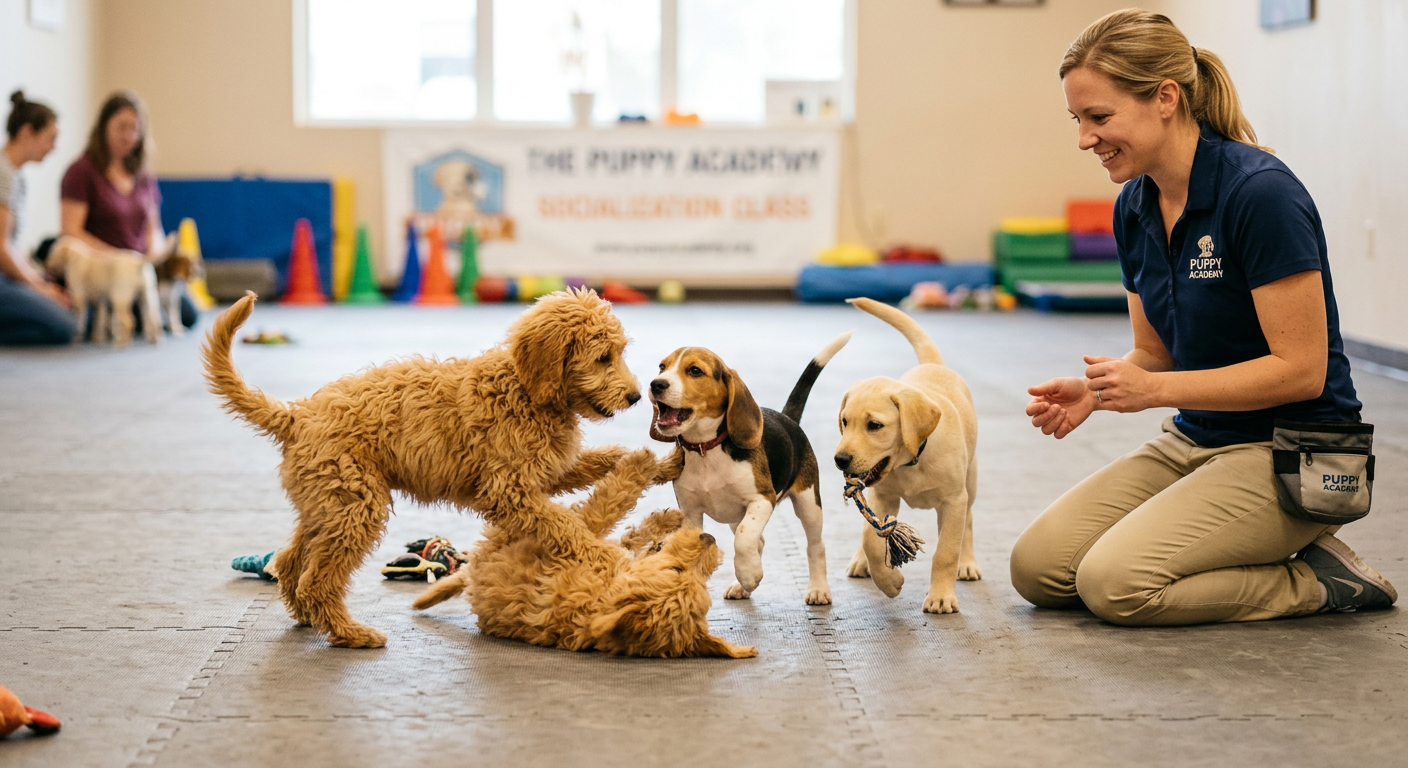
What Happens in a Dog Socialization Class?
So what exactly goes on in dog socialization classes? My mom Lacey did her homework before enrolling me, and here's what she found — and what I experienced with my own four paws.
A well-run puppy socialization class typically includes:
- Supervised puppy-to-puppy interaction — Puppies are grouped by size and temperament so nobody gets overwhelmed. A professional trainer watches every interaction and steps in if things get too rowdy.
- Exposure to new stimuli — Think different surfaces (metal grates, wobbly boards, carpet), sounds (thunder recordings, doorbells), objects (umbrellas, strollers), and people of different ages and appearances.
- Basic obedience foundations — Sit, stay, come, and loose-leash walking are usually introduced using positive reinforcement.
- Bite inhibition training — This is HUGE. Puppies learn to control the pressure of their mouths during play. Trust me, those little needle teeth are no joke.
- Owner education — Maybe the most underrated part. Your human learns how to read canine body language, reinforce good behavior, and handle common puppy challenges.
Research indexed on PubMed confirms that these structured classes benefit not just the dogs but also owners, veterinarians, and the broader community by producing well-adjusted, confident canine citizens.
One thing my mom Lacey always says: "The best investment I ever made in Auggie was that first puppy class." And honestly? She's right. It gave me the confidence to strut into any dog park, vet office, or outdoor café like I own the place. (I kind of do.)
The Dog Park Question: Fun or Risky for Puppies?
Now, let's talk about dog parks. Don't get me wrong — I LOVE a good dog park. The smells! The zoomies! The questionable tennis balls that have been in who-knows-how-many mouths! Dog parks are fantastic for adult dogs who are already well-socialized and vaccinated. But for a young puppy? That's where things get complicated.
Here's the reality: dog parks are uncontrolled environments. You have no idea about the vaccination status, temperament, or training level of the other dogs there. For a tiny puppy in the middle of their critical socialization window, one bad experience — a snap from an adult dog, a chase that goes too far — can leave a lasting negative impression.
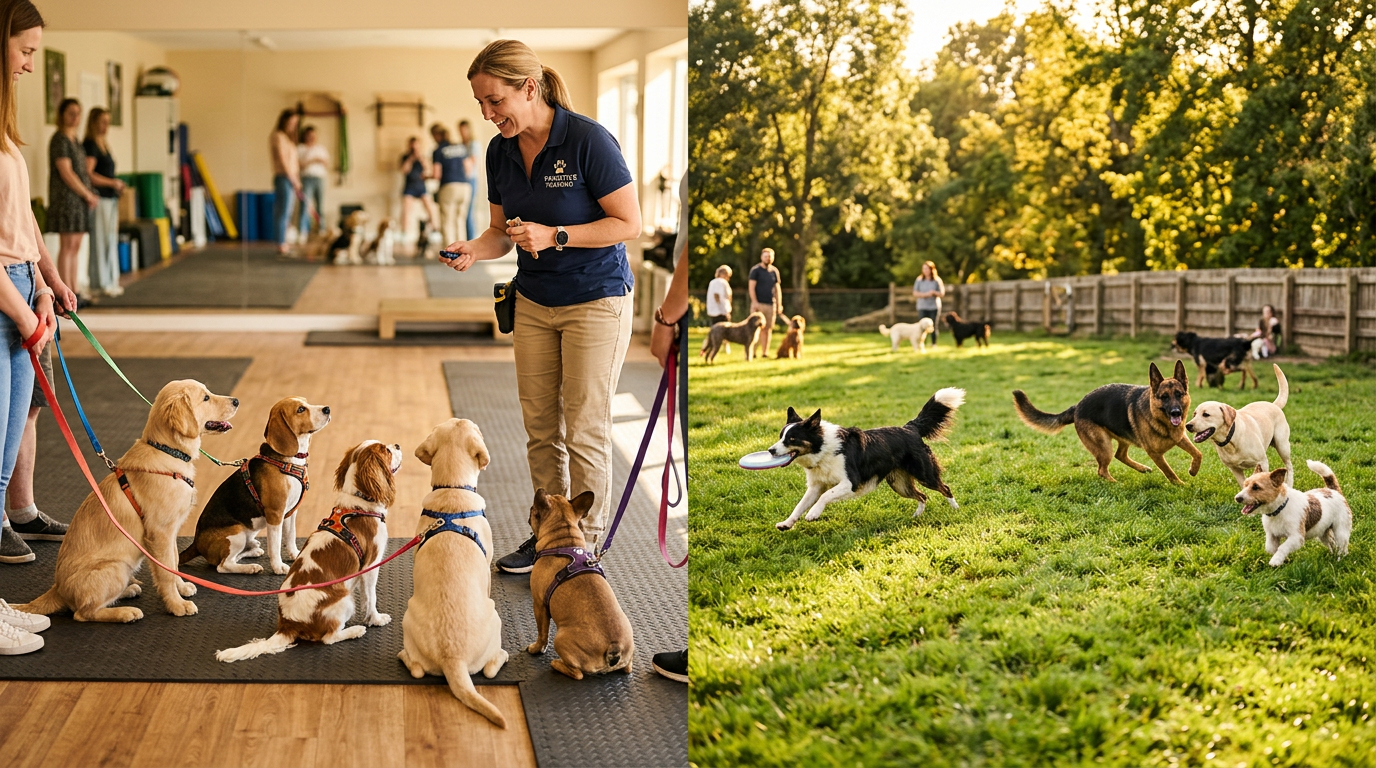
Here's what makes dog parks risky for young puppies:
- No size or age grouping — Your 10-week-old Cavalier King Charles could end up being body-slammed by a 90-pound Labrador. Yikes.
- Disease exposure — Parvovirus can live in soil for months. DVM360 reports that puppies in well-run classes with vaccination requirements face very low risk of infectious disease, but the same can't be said for public dog parks where vaccination isn't enforced.
- Unpredictable dog behavior — Not every dog at the park has good manners. Some are reactive, some are resource guarders, and some just play too rough for a baby pup.
- No professional oversight — There's no trainer watching body language, redirecting escalating play, or coaching you on what's normal and what's not.
That said, dog parks aren't the enemy. They're just not the right first step. Think of it this way: puppy socialization classes are kindergarten, and the dog park is recess at a big kid school. You've gotta earn your way there.
Puppy Socialization Classes vs. Dog Parks: A Side-by-Side Comparison
Let me break it down the way I see it — with my nose to the ground and my ears perked up.
| Feature | Puppy Socialization Classes | Dog Parks |
|---|---|---|
| Environment | Controlled, sanitized, structured | Open, uncontrolled, variable |
| Supervision | Professional trainer present | No professional oversight |
| Age/size grouping | Yes — matched by age and size | No — all ages and sizes mixed |
| Vaccination requirements | Required before enrollment | Not enforced |
| Disease risk | Very low with proper protocols | Higher, especially for unvaccinated pups |
| Behavioral guidance | Trainer intervenes and coaches | You're on your own |
| Socialization quality | High — positive, structured exposure | Variable — can be positive or traumatic |
| Cost | Typically $100–$250 for a series | Usually free |
| Best for | Puppies 7–16 weeks | Well-socialized, fully vaccinated adult dogs |
The takeaway? Puppy socialization classes provide a foundation. Dog parks are a graduation reward.
When to Transition from Puppy Socialization Class to Dog Park
So when is your pup ready for the dog park? According to VCA Animal Hospitals, puppies should ideally complete their full vaccination series (usually around 16 weeks) before being exposed to environments where unknown dogs congregate.
But vaccination isn't the only milestone. Here's my personal checklist — Auggie-approved:
- Full vaccination series complete — All core vaccines, including the final parvo/distemper booster.
- Reliable recall — Your pup comes when called, even with distractions. (Okay, "reliable" is a strong word. Let's say "mostly responsive.")
- Good play skills — They know how to take turns, respect other dogs' space, and disengage when play gets too intense.
- Confidence without reactivity — They can encounter new dogs without cowering or lunging.
- Your comfort level — You, the human, feel confident reading the park's energy and knowing when to leave.
My mom Lacey didn't take me to a full-sized dog park until I was about 5 months old, and even then, she chose off-peak hours so I wouldn't be overwhelmed. Smart human, that one.
Essential Gear for Puppy Socialization Success
Whether you're heading to a puppy socialization class or eventually graduating to the dog park near you, having the right gear makes all the difference. Here are some products my mom Lacey swears by — and I've personally tested with my teeth, paws, and unrelenting enthusiasm:
Training Treats
You can't do positive reinforcement without something delicious. I'm a fan of the Zuke's Mini Naturals Training Treats — they're small, soft, and come in flavors that make my tail go absolutely haywire. Perfect for rewarding good behavior in class without filling up your pup's tiny tummy.
A Quality Harness
For puppy classes and walks to the park, a well-fitting harness is essential. The Rabbitgoo Dog Harness is a favorite in our house. It's adjustable, doesn't put pressure on your pup's developing throat, and has a front clip to discourage pulling.
Treat Pouch
Your human needs quick access to those treats during class. The PetSafe Treat Pouch Sport clips right onto a belt or waistband and has a magnetic closure so your mom or dad can grab a reward in seconds. Trust me, timing matters when you're trying to reinforce a perfect sit.
Interactive Toy for Confidence Building
Exposing your puppy to novel objects is a huge part of socialization. The KONG Puppy Toy is a classic for a reason — stuff it with a little peanut butter and it becomes a confidence-building puzzle that keeps your pup engaged and happy.
Portable Water Bowl
Staying hydrated during class or at the park is a must. The MalsiPree Collapsible Dog Bowl folds flat, clips onto a leash or bag, and is easy to clean. My mom Lacey never leaves the house without one.
Tips for Choosing the Best Puppy Socialization Classes Near You
Not all puppy socialization classes are created equal. Here's what to look for when searching for options in your area:
- Positive reinforcement methods only — The trainer should use treats, praise, and play — never punishment, choke chains, or dominance-based techniques. Today's Veterinary Practice emphasizes that positive reinforcement is the gold standard for puppy training.
- Vaccination requirements — A reputable class will require proof of at least one set of vaccines administered 7–10 days before enrollment.
- Clean, sanitized space — The training area should be cleaned between sessions. Ask about their sanitation protocol.
- Small class sizes — Look for classes with 6–8 puppies maximum so every pup gets individual attention.
- Qualified instructor — Certifications from organizations like the Certification Council for Professional Dog Trainers (CCPDT) or Karen Pryor Academy are great indicators.
- Off-leash play time — The best classes include supervised off-leash interaction, not just obedience drills.
- Puppy-specific enrollment — Make sure the class is specifically for puppies (usually under 16–20 weeks), not a general "beginner" class with adult dogs mixed in.
Pro tip from yours truly: ask if you can observe a class before enrolling. Watch how the trainer handles an overwhelmed or mouthy puppy. That tells you everything you need to know.
The Long-Term Benefits of Proper Puppy Socialization
Here's the thing that really gets my tail wagging: the benefits of puppy socialization classes don't just last a few weeks. They shape who your dog becomes for their entire life.
Poorly socialized puppies face a significantly greater risk of developing fear and aggression toward other dogs and people. According to the AVSAB, behavioral problems are the number one cause of relinquishment to shelters. That means proper socialization doesn't just make life better — it can literally save a dog's life.
Studies also show that owners who invest in puppy training classes are much more likely to keep their pets long-term and develop stronger bonds with them. My mom Lacey can confirm — those early classes brought us closer together. She learned to understand my body language, and I learned that she's got an endless supply of those Zuke's treats in her pocket.
The confidence I built in my puppy socialization class carried over into everything: vet visits, grooming appointments, meeting strangers, traveling, and yes — absolutely crushing it at the dog park. I'm the dog who greets every newcomer with a play bow and a wagging tail, and that didn't happen by accident. It happened because my human gave me the right foundation at the right time.
So there you have it, friends — the full sniff-down on puppy socialization classes versus dog parks. If you're raising a young pup, classes are the way to start. They're safe, structured, and set your furry friend up for a lifetime of confidence and good manners. Dog parks are the cherry on top once your puppy has the skills and vaccinations to handle the big leagues.
My mom Lacey always says that enrolling me in my first puppy socialization class was the single best decision she made as a new dog parent, and I couldn't agree more (I mean, I got treats AND new friends — what's not to love?). So do your research, find a great class near you, gear up with the right supplies, and give your puppy the gift of a well-socialized life. Your future self — and your future dog — will thank you.
Now if you'll excuse me, I've got a dog park date to get to. 🐾
Borks and tail wags, Auggie
Frequently Asked Questions
What is the 3-3-3 rule for puppies?
The 3-3-3 rule is a guideline for what to expect when bringing a new puppy (or rescue dog) home. In the first 3 days, your puppy may feel overwhelmed, not eat much, and hide or test boundaries. After 3 weeks, they'll start settling into a routine, showing more of their true personality, and getting comfortable in their new environment. After 3 months, your puppy should feel fully at home, bonded with your family, and settled into their routine. It's a helpful framework for managing expectations and being patient with your new furry family member.
What is the best age to socialize a puppy?
The best age to socialize a puppy is during their critical socialization window, which falls between 3 and 14 weeks of age. The American Veterinary Society of Animal Behavior (AVSAB) recommends starting puppy socialization classes as early as 7 to 8 weeks, as long as your puppy has received at least one set of vaccines 7–10 days prior. The earlier you start exposing your puppy to new people, animals, sounds, and environments in a safe way, the more confident and well-adjusted they'll be as an adult dog.
What is the 10-10-10 rule for puppies?
The 10-10-10 rule is a socialization guideline suggesting that before your puppy reaches a certain age (usually around 12–16 weeks), they should have positive experiences with at least 10 different surfaces (grass, tile, gravel, metal grates), 10 different people (varying in age, gender, appearance, and clothing), and 10 different locations (pet stores, parks, friends' houses, parking lots). This structured approach ensures your puppy gets broad, diverse exposure during their critical developmental period, helping prevent fear-based behaviors later in life.
What is the 7 7 7 rule for dogs?
The 7-7-7 rule is another socialization framework that recommends your puppy experience at least 7 different surfaces, 7 different toys or objects, 7 different locations, 7 different challenges (like climbing small steps or walking through a tunnel), meet 7 different people, eat from 7 different containers, and be exposed to 7 different sounds — all before they're 7 weeks old (or within their first weeks in your home). It's designed to create a well-rounded, confident puppy by ensuring diverse, positive experiences across many categories during the critical socialization period.
About Auggie
Hi, I'm Auggie! I'm a Golden Doodle who's been to more dog parks than most humans. My mom Lacey and I started Doggie Park Near Me to help every pup find their perfect park. When I'm not sniffing out new spots, you'll find me napping in the sun or begging for treats.
Learn more about us →More From Auggie

Dog Parks as Socialization Tools: Do's and Don'ts for a Happy, Well-Adjusted Pup
Hey, it's Auggie! Dog park socialization can be a game-changer — or a total disaster if you do it wrong. I'm sharing the do's and don'ts of using dog parks as socialization tools, from vaccination must-knows to reading canine body language. Let's make every park visit a tail-wagging success!

Puppy Socialization Checklist: Everything Your Pup Needs to Experience
Hey there, it's Auggie! I put together the ultimate puppy socialization checklist so your new pup can experience everything — people, sounds, surfaces, and more — during that critical 3-16 week window. Packed with expert tips, product picks, and my own Golden Doodle wisdom!

Auggie’s playful guide to a doggie park near me
Hi, I'm Auggie the Golden Doodle and I'm on a mission to uncover the best doggie park near me! In my ultimate guide, you'll discover local adventure tips, safety insights, and the must-have gear for fun, tail-wagging visits. Join me as I sniff out the perfect park spots and share firsthand advice on making every park day a joyous, healthy romp. Come along on this local journey—click to learn more!